
What Is an M4? (M4 Carbine Explained)
If you’ve spent any time around firearms, you’ve probably heard the term “M4” thrown around at the range, in online forums, or while shopping for your next build. But what exactly is an M4, and why does it matter to civilian shooters and collectors? This comprehensive guide breaks down everything you need to know about the M4 carbine—from its military origins to its massive influence on today’s AR-15 market and the customization options that let you make your rifle truly yours.
Quick Answer: What Is an M4 Carbine?
The M4 carbine is a 5.56×45mm NATO caliber, gas operated, magazine fed, select-fire carbine derived from the M16 family of rifles. It was developed as a shorter and lighter variant of the full-length M16 and officially adopted by the US military in the 1990s for use by vehicle crews, special operations units, and eventually standard infantry.
What sets the M4 apart from its M16 predecessor is its 14.5-inch barrel (compared to the M16’s 20-inch barrel) and its collapsible stock, which allow for better maneuverability in close quarters combat while still maintaining effectiveness out to roughly 500–600 meters. The shortened version of the original rifle made it ideal for urban warfare, vehicle operations, and any situation where a full-length rifle would be cumbersome.
By around 2010, the M4 had become the primary service rifle for the United States Army, and by the mid-2010s, it had broadly replaced the M16A2 and M16A4 in frontline units across both the Army and Marine Corps. The M4 carbine has over 80% parts commonality with the M16A2 rifle, making maintenance and logistics simpler for military units. The M4 also replaced most submachine guns and selected handguns in U.S. military service due to its effective rifle ammunition, offering greater range and stopping power than submachine guns in modern combat scenarios. Today, it remains the standard issue firearm for most units in the US Army and sees service in over 60 countries worldwide.
In the civilian world, “M4” has become shorthand for any semi automatic rifle styled after the military carbine—commonly called “M4-style AR-15s.” These civilian versions maintain the look and feel of the military rifle but are limited to semi auto fire to comply with federal law.
Why does this matter to you as a shooter or accessory buyer? The M4’s dominance in the modern rifle market means that accessories, magazines, and components designed for M4-style builds are everywhere. From custom PMAGs and dust covers to rail systems and backplates, the aftermarket for these carbines is enormous—and that’s exactly where My Southern Tactical comes in, offering custom-designed accessories that let you personalize your build with unique graphics and finishes.
Classification and Terminology: Understanding the M4
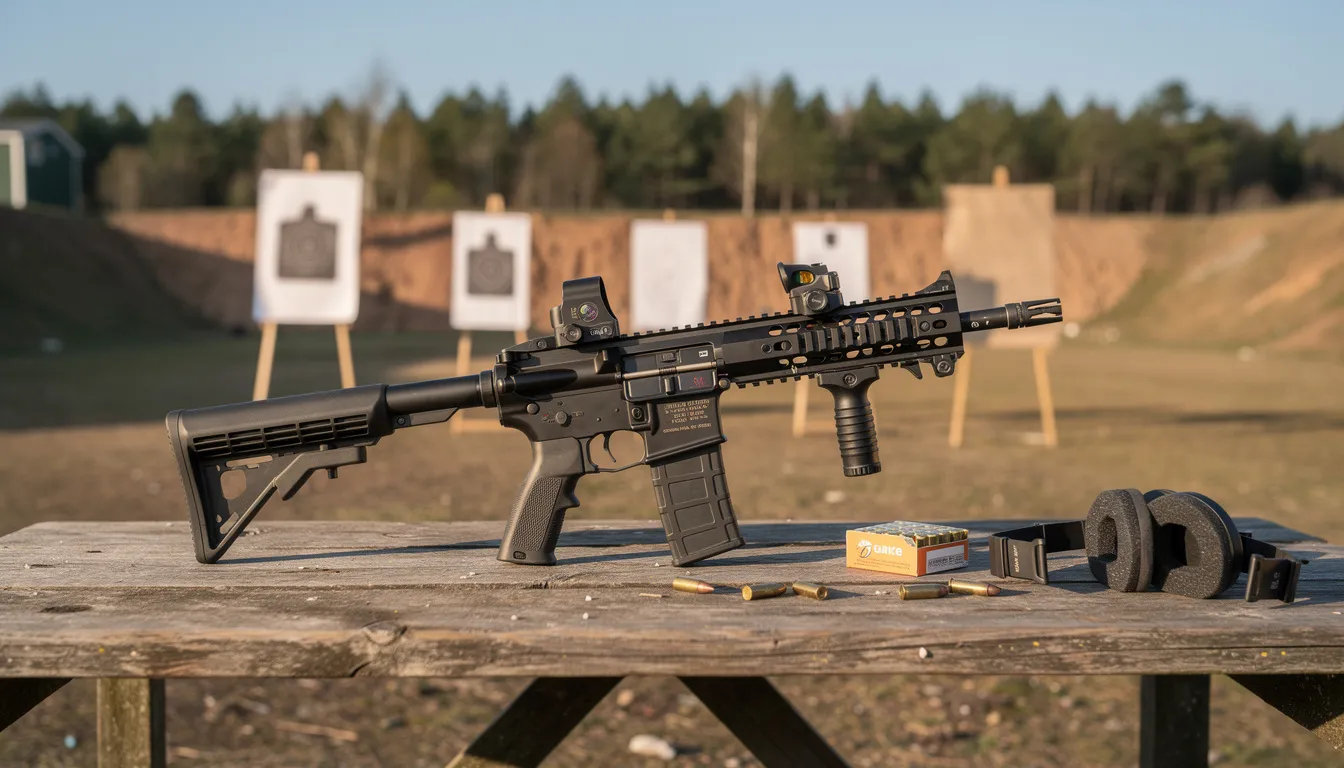
When discussing the M4, it’s important to understand how this iconic firearm is classified and what the terminology really means—especially as it relates to both military and civilian contexts.
The M4 is officially categorized as a carbine, which is essentially a shorter and lighter variant of a standard service rifle. Carbines are designed for increased maneuverability, making them ideal for vehicle crews, special operations units, and any scenario where a full-length rifle would be cumbersome. The M4’s 14.5-inch barrel length and collapsible stock are defining features that set it apart from traditional rifles, allowing it to function as a highly effective shoulder fired weapon in close quarters and dynamic environments.
In military terms, the M4 is considered an assault rifle due to its selective fire capability—meaning it can switch between semi automatic and either burst fire or fully automatic modes, depending on the variant. This selective rate of fire is a hallmark of military rifles, distinguishing them from civilian semi automatic rifles, which fire only one round per trigger pull.
The terminology can get confusing, especially since the AR-15 platform (from which the M4 is derived) is often called a “rifle” or “carbine” depending on its configuration. In the civilian world, “M4-style” typically refers to a semi automatic, magazine fed, air cooled firearm that visually and functionally mirrors the military M4, but is limited to semi auto operation for legal reasons.
Development and History of the M4
The M4 carbine’s lineage traces directly back to Eugene Stoner’s revolutionary AR-15 design from the late 1950s. When the US military adopted the AR-15 as the M16 rifle during the Vietnam War era, it represented a dramatic shift from the heavier .30-caliber battle rifles that came before. The M16 was lighter, fired a smaller caliber round, and allowed soldiers to carry more ammunition—but it was still a full-length rifle that proved awkward in certain tactical situations.
Almost immediately after the M16’s adoption, the military began experimenting with shorter carbine versions. During the late 1960s and into the 1970s, Colt developed the CAR-15 and XM177 series—essentially shortened M16s with telescoping stocks and shorter barrels. These early shoulder fired weapon variants saw limited use by special operations forces in Vietnam, proving the concept of a compact 5.56mm carbine but also revealing reliability issues that needed solving.
The real development push for what would become the M4 started in the early 1980s. Colt began working on the XM4, refining the design based on lessons learned from earlier carbines. The Army conducted extensive testing, and by 1984, the design had received formal approval. Over the next several years, incremental improvements addressed the feeding and cycling issues that had plagued earlier short-barreled AR variants.
A pivotal moment came during the 1993 Battle of Mogadishu in Somalia. American forces engaged in intense urban combat found that the compact carbines used by some units offered significant advantages in the close-range fighting that characterized the operation. This experience accelerated the military’s interest in fielding the M4 more broadly, as it highlighted the carbine’s advantages in urban and vehicle-based operations.
Throughout the late 1990s and early 2000s, the M4 saw increasing adoption. The US Army began phasing it in as the primary infantry weapon around 2010, while the Marine Corps followed suit by the mid-2010s. The Global War on Terror, with its emphasis on urban combat and counterinsurgency operations in Iraq and Afghanistan, proved the M4’s worth in exactly the kind of fighting it was designed for.
Today, the M4 carbine serves in over 60 countries and is used by countless law enforcement agencies worldwide. Its combination of manageable size, adequate range, and compatibility with the vast M16/AR-15 parts ecosystem has made it the defining military rifle of the early 21st century—and the foundation for millions of civilian builds.
Technical Characteristics and Features of the M4
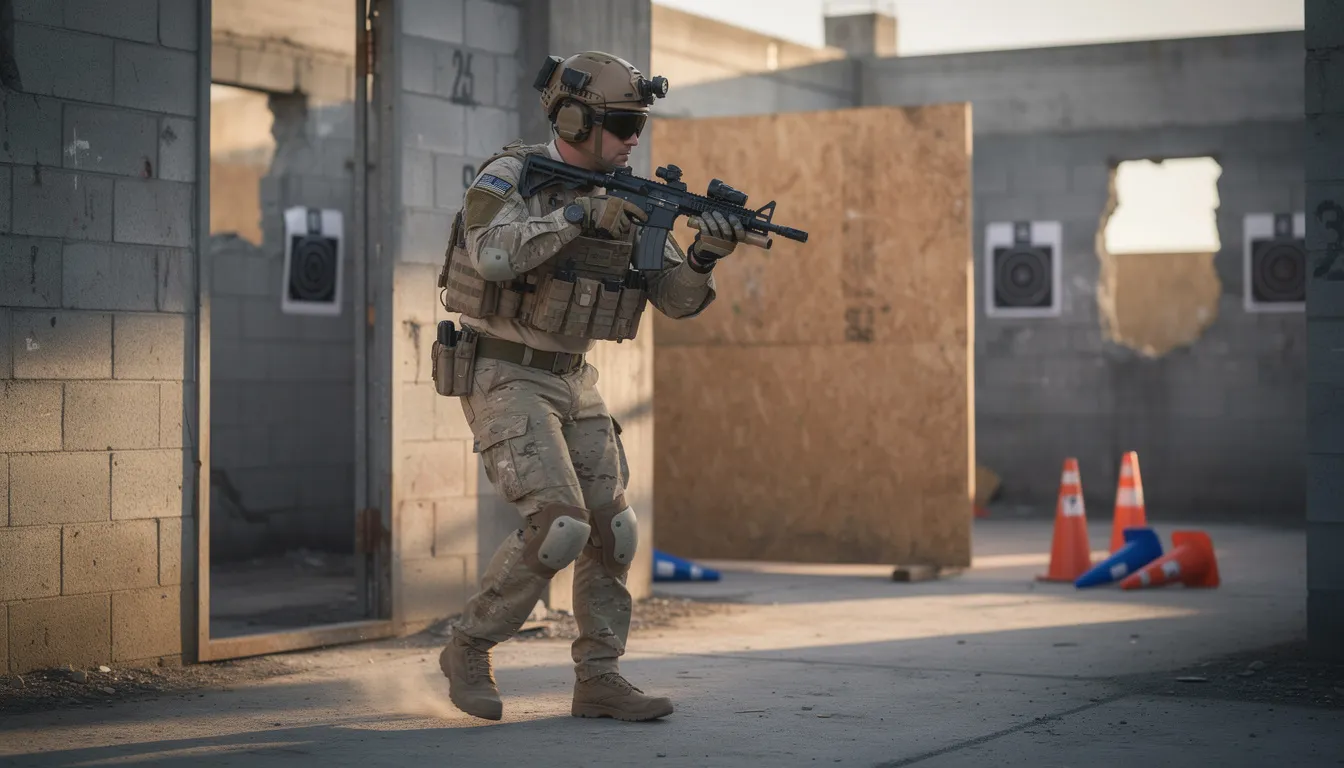
At its core, the M4 is a lightweight, gas operated, air cooled, magazine fed, shoulder fired weapon with a telescoping stock and selective fire capability. The M4 carbine is classified as a selective fire weapon, allowing for both semi-automatic and fully automatic fire. Standard military M4s offer safe, semi automatic, and either three round burst (original M4) or fully automatic (M4A1) firing modes via the trigger assembly. This selective rate capability distinguishes the military rifle from civilian semi-auto versions.
The dimensions tell the story of why this carbine excels in tight spaces:
-
Overall length: Approximately 33 inches with stock extended, about 29.7 inches with stock collapsed
-
Barrel length: 14.5 inches (compared to 20 inches on the M16)
-
Weight: Around 7.3–7.5 pounds with an empty 30-round magazine
-
Caliber: 5.56×45mm NATO (also compatible with .223 Remington in most cases)
The M4 carbine is equipped with a collapsible stock, making it more maneuverable in tight spaces.
The operating system uses a direct impingement-style gas system, where propellant gases are tapped from the barrel through a gas tube and directed back into the bolt carrier to cycle the action. This design keeps the gun relatively simple and contributes to the accuracy and consistent trigger pull that shooters appreciate. The tradeoff is that carbon fouling gets deposited directly into the receiver, requiring regular cleaning for optimal reliability—though modern ammunition and lubricants have largely mitigated this concern. The M4's reliability has increased as the design was upgraded, achieving 1,691 mean rounds between stoppages with the M4A1 version.
Standard components on a military M4 include a flat-top upper receiver with a Picatinny rail for mounting optics, either a detachable carry handle with iron sights or backup iron sights (BUIS), handguards or modular rail systems for accessories, and the signature collapsible stock. The design and customization options of the M4's grip allow users to select materials and ergonomics that best suit their handling and comfort preferences, enhancing overall firearm control. The gun feeds from 30-round STANAG-pattern magazines, including modern polymer options like PMAGs. This is where customization really comes into play—magazines are one of the easiest and most visible ways to personalize your build, and custom magazines with unique graphics from My Southern Tactical let your firearm reflect your personality.
In terms of performance, the M4 delivers:
-
Effective range: Approximately 500–600 meters for point targets
-
Rate of fire: Cyclic rate of about 700–950 rounds per minute (in full-auto variants)
-
Muzzle velocity: Approximately 2,900–3,000 fps with standard M855/M855A1 ammunition from the 14.5” barrel
The M4 carbine has been used for close quarters operations where the M16 would be too long and bulky to use effectively. One of the M4’s greatest strengths is its parts commonality with the M16 family. The lower receiver, bolt, and most small parts are interchangeable, with roughly 80% or more parts compatibility. For the military, this simplifies logistics and maintenance. For civilian shooters, it means the massive aftermarket for AR-15 components works perfectly with M4-style builds. In December 2006, a report indicated that 94% of soldiers rated the M4 as an effective weapons system.
M4 vs. AR-15 and M16: Key Differences
Understanding the difference between these three designations clears up a lot of confusion in the firearms world. The “AR-15” is the foundational semi automatic rifle design created by Eugene Stoner and ArmaLite in the 1950s. “M16” and “M4” are US military designations for select-fire versions of that basic system. Essentially, the M16 and M4 are specialized military variants of the AR-15 platform, developed for military service and equipped with fully automatic or burst fire capabilities.
The most obvious physical difference is barrel length. The M16A2 and M16A4 feature 20-inch barrels, while the M4 carbine uses a 14.5-inch barrel. This shorter barrel reduces muzzle velocity somewhat (losing roughly 100–150 fps compared to the M16) and theoretically decreases effective range, but the practical difference for most combat engagements is minimal. What the shorter barrel does provide is dramatically improved handling, especially inside vehicles, buildings, and other confined spaces. The heavier barrel profile on the M4A1 variant helps manage heat during sustained fire.
Stock configuration is another key difference. The M16 uses a fixed stock, while the M4 features a collapsible stock that adjusts to different lengths of pull. This adjustability accommodates soldiers wearing body armor, allows for more compact storage, and lets the carbine version fit a wider range of shooters. It’s become so popular that collapsible stocks are now standard on most civilian AR-15 builds as well.
The critical legal difference involves fire control. Military M4s are machine gun variants capable of firing more than one round per one trigger pull—either three round burst in the original M4 or fully automatic in the M4A1. Civilian AR-15s and M4-style carbines are strictly semi automatic, firing only one round per trigger pull. Under U.S. law, the National Firearms Act (NFA) heavily regulates machine gun ownership, and the Hughes Amendment of 1986 banned civilian purchase of any machine gun manufactured after that date. This means a true select-fire M4 is essentially unobtainable for most civilian buyers.
Accessory mounting has evolved across all platforms. Early M16s relied primarily on fixed carry handles and basic handguards, while the M4 evolved alongside the SOPMOD (Special Operations Peculiar Modification) program that emphasized modular accessories. Modern M4s feature flat-top receivers and rail systems as standard, a configuration that’s become universal across civilian AR-15s too.
A note on nomenclature: many civilian firearms are marketed as “M4-style,” “M4gery,” or simply “M4” despite being semi-auto-only AR-15 pattern rifles. Colt’s trademark on the M4 name was effectively ruled generic in U.S. legal decisions during the 2000s, so manufacturers freely use the designation.
For My Southern Tactical customers, here’s the practical takeaway: whether you run a true M4-style AR-15 carbine or a full-length rifle, the magazines, dust covers, and cosmetic accessories are largely interchangeable. The same custom PMAG that looks great on a 16-inch carbine will work perfectly on a 20-inch rifle, so your customization options remain wide open regardless of your specific build.
M4 Variants and Modern Upgrades
Since its initial fielding, the M4 family has undergone over 90 engineering changes and spawned multiple named variants. The US Army and special operations units continuously improved the platform’s reliability, ergonomics, and modularity throughout the 1990s, 2000s, and 2010s.
The original M4 featured three round burst fire control (instead of full-auto), a thinner government-profile barrel, and relatively basic handguard configurations. While functional, operators and armorers identified several areas for improvement—particularly concerning the trigger assembly feel during burst fire, barrel overheating during sustained use, and the need for better accessory mounting.
The M4A1 emerged as the principal upgraded variant and eventually became the standard for most units. The M4A1 possesses a thicker barrel and a fully automatic fire control group, replacing the burst-fire control group found in the standard M4. Key improvements include:
-
Full-auto fire control replacing three-round burst, giving soldiers more flexibility in how they engage area targets
-
Heavier “SOCOM” barrel profile that better resists heat buildup during sustained automatic fire
-
Improved trigger consistency eliminating the inconsistent trigger pull issues associated with burst mechanisms
-
Ambidextrous controls on later production models for better handling by left-handed shooters
Upgrading M4s to M4A1s provides benefits such as full auto capability, a consistent trigger pull, and a more durable barrel. The M4A1 upgrade increases the weapon's weight from 7.46 lb to 7.74 lb, which includes additional components like a back-up iron sight and forward pistol grip. The M4A1 also features an ambidextrous selector lever for easier use by left-handed shooters, enhancing its usability. The M4A1's fully automatic trigger provides a more consistent trigger pull, which leads to better accuracy compared to the M4's burst fire.
The M4 Product Improvement Program (PIP), conducted in two phases from roughly 2011 to 2014, converted large numbers of existing M4s to M4A1 standard. This conversion program updated triggers, barrels, bolts, and rails across the Army’s inventory, enhancing reliability and accuracy while maintaining the core platform. The Army plans to upgrade all of its M4s to M4A1s as part of this Product Improvement Program, which includes the conversion of 300,000 M4 carbines to the M4A1 standard. The M4A1 upgrade program is budgeted at $240 per rifle, totaling approximately $120 million for half a million conversions. The U.S. Army began fielding newly built M4A1s in 2012, with the 1st Infantry Division being the first unit to convert their M4s to M4A1-standard in May 2014. The M4A1 is now used by almost all U.S. special operation units and is the standard service rifle across the U.S. Army. The army awarded contracts to manufacturers for M4A1 production and upgrades as part of this modernization effort.
Special operations units drove many innovations through programs like SOPMOD (Special Operations Peculiar Modification), which bundled optics, vertical grips, weapon lights, lasers, suppressors, and other accessories into standardized kits. Specialized upper receiver groups like the CQBR (Close Quarters Battle Receiver) with its even shorter barrel and the SPR (Special Purpose Receiver) for designated marksman roles expanded the M4’s versatility within special operations.
More recent developments include the M4 MWS (Modular Weapon System) and URG-I (Upper Receiver Group – Improved), which incorporate free-float handguards (like the Geissele Mark 16 M-LOK rail), improved gas system tuning, and upgraded barrels for enhanced accuracy. These improvements represent the current cutting edge of M4 development for the conventional Army.
What matters for civilian shooters is that virtually every enhancement developed for military M4s has filtered into the commercial AR-15 market. The rail systems, improved stocks, match-grade triggers, and upgraded bolt carriers available to consumers today trace directly back to military improvement programs. Even your magazine choices—whether standard aluminum, Magpul PMAGs, or custom graphic-enhanced magazines from My Southern Tactical—reflect this decades-long evolution of the platform.
Tactical Operations: The M4 in Action
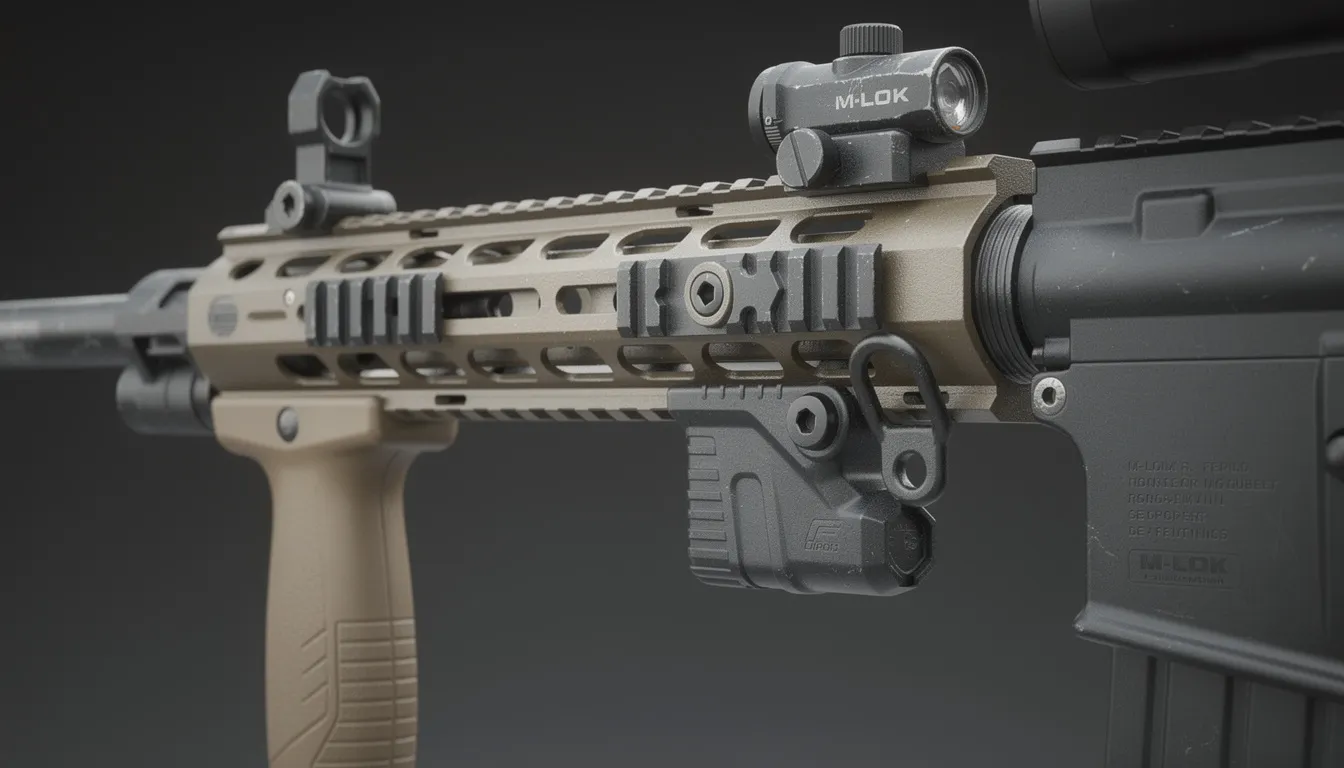
The M4 carbine’s reputation was forged in the heat of real-world tactical operations, where its design features have proven invaluable time and again. Its shorter barrel and collapsible stock make it the weapon of choice for close quarters combat, allowing soldiers and special operations units to maneuver quickly through tight spaces, vehicles, and urban environments.
In the hands of the US Army and elite special operations units, the M4 has excelled in missions ranging from room clearing and hostage rescue to vehicle interdiction and rapid assaults. Its lightweight construction means less fatigue during long patrols, while the air cooled, gas operated system ensures reliable performance even under sustained fire. The ability to quickly transition between semi automatic and burst or fully automatic fire (in military variants) gives operators the flexibility to engage both point and area targets as the situation demands.
Customization options—such as advanced optics, rail systems for mounting lights and lasers, and ergonomic grips—allow each unit or individual to tailor the M4 to their specific mission requirements. This adaptability has made the M4 a staple not just for infantry, but also for specialized roles like designated marksman, breacher, or vehicle crew member.
For civilian shooters, these same features translate into a firearm that’s equally at home in competition, home defense, or recreational shooting. The M4’s accuracy, consistent trigger pull, and modularity make it a top choice for those who demand performance and reliability in any scenario.
Replacement Efforts and Competing Platforms
Since the 1980s, the US military has repeatedly explored replacing the M16/M4 system, seeking increased reliability, lethality, and modularity. Despite these efforts spanning decades and billions of dollars, the M4 remained dominant through multiple replacement attempts—a testament to its fundamental soundness as a combat weapon.
Early replacement attempts included the Advanced Combat Rifle (ACR) program of the late 1980s and the XM29 Objective Individual Combat Weapon (OICW) program of the 1990s and early 2000s. The ACR program tested exotic designs including flechette-firing rifles and caseless ammunition systems, but none demonstrated sufficient improvement over the M16/M4 to justify the massive cost of adoption. The OICW attempted to combine a rifle with a smart grenade launcher but proved too heavy, too complex, and too expensive for widespread fielding.
Several noteworthy competitors emerged over the years:
HK416: Heckler & Koch developed this short-stroke gas piston carbine as a more reliable alternative to the direct impingement M4. While the US Army never adopted it as a standard issue weapon, various special operations forces used it extensively. Most notably, the Marine Corps adopted a variant as the M27 Infantry Automatic Rifle (IAR), initially as a squad automatic weapon but increasingly as a standard rifle.
FN SCAR: The Special Operations Command briefly fielded the FN SCAR rifle family in the 2000s. While the SCAR offered genuine modularity (easily switching between 5.56mm and 7.62mm configurations), it never demonstrated enough advantage over updated M4A1s to justify widespread adoption. SOCOM eventually scaled back SCAR purchases.
Individual Carbine Competition: In the 2010s, the Army ran a formal competition to find an M4 replacement, with entries from Colt, Remington, Heckler & Koch, and FN. After extensive testing, the competition was canceled in 2013 without selecting any replacement—essentially affirming that the M4A1, with ongoing improvements, remained sufficient for foreseeable needs.
Despite decades of replacement attempts, surveys and after-action reviews from Iraq and Afghanistan consistently showed high user satisfaction with the M4. Properly maintained and cleaned M4s demonstrated reliability rates of 85–95% satisfaction among troops, with users praising its handling, accuracy, and ergonomics in actual combat conditions.
Looking forward, newer Next Generation Squad Weapon (NGSW) platforms firing 6.8mm ammunition are beginning to enter service, potentially representing the first true successor to the M4 for some infantry units. However, the M4 pattern and its vast ecosystem of accessories will remain common in civilian and law enforcement use for many years to come. The millions of M4-style rifles in circulation ensure continued demand for magazines, components, and customization options.
Civilian “M4-Style” Rifles and Customization
In the civilian market, “M4” has become practically synonymous with a specific type of AR-15 build: carbines with 16-inch barrels (the federal minimum without NFA registration), collapsible stocks, flat-top upper receivers, and styling that visually mirrors the military carbine. These firearms are popular for home defense, competition, range shooting, and collecting.
The legal landscape shaped this market significantly. During the 2000s, court decisions effectively ruled Colt’s “M4” trademark generic, allowing virtually any manufacturer to market carbines under the M4 name or with “M4-style” descriptors. This opened the floodgates for affordable M4-pattern rifles from dozens of manufacturers, making the platform accessible to millions of American gun owners.
This explosion of M4-style builds created massive demand for aftermarket parts and accessories. The modular nature of the AR-15/M4 platform means shooters can easily swap:
-
Free-float handguards and rail systems
-
Upgraded triggers for better accuracy and a more consistent trigger pull
-
Muzzle devices including compensators, flash hiders, and suppressor mounts
-
Stocks ranging from basic to fully adjustable competition models
-
Optics from simple red dots to magnified scopes
-
And of course, magazines and cosmetic components
Typical civilian use cases for M4-style rifles include:
-
Home defense builds optimized for maneuverability indoors with shorter barrels (16” or SBR configurations) and weapon lights
-
Competition rifles set up for 3-gun or other practical shooting sports with lightweight components and precision triggers
-
Range and training carbines for recreational shooting and skills development
-
“Clone” builds that replicate specific military M4 configurations from Iraq (2003–2011) or Afghanistan (2001–2021) for historical interest or collector value
This is where customization gets personal—and where My Southern Tactical shines. Our custom accessories let you make your M4-style build truly unique:
Custom PMAGs and AR-15 magazines feature unique artwork ranging from patriotic themes and unit-style motifs to personal designs you create yourself. These aren’t just functional accessories—they’re conversation starters at the range and expressions of your personality.
Laser-engraved and printed dust covers match your build’s theme with caliber markings, humorous sayings, morale-style graphics, or custom artwork. It’s one of the most visible customization options when your bolt locks back.
Glock backplates and other handgun accessories let you coordinate your sidearm with your primary carbine, creating a cohesive aesthetic across your entire collection.
All products are designed and manufactured in-house at our Casselberry, Florida workshop. We offer made-to-order finishes and graphics, so you’re not limited to what’s on the shelf. Our core philosophy is simple: either choose from our existing designs or upload your own artwork to create fully personalized accessories that make your build stand out.
Choosing Accessories for Your M4-Style Build
Whether you’re building your first M4-style AR-15 or upgrading an existing carbine, thoughtful accessory selection enhances both function and aesthetics. Here’s a practical guide to making your rifle work better and look better.
Functional Upgrades to Consider
Start with the accessories that improve your shooting experience:
-
Reliable magazines: Quality 30-round polymer magazines like PMAGs ensure consistent feeding. Stock up—you’ll want spares for range days and training
-
Optics: Even a basic red dot dramatically improves target acquisition over iron sights alone. Match your optic choice to your primary use case
-
Weapon lights: Essential for any home defense build, allowing target identification in low light
-
Slings: A quality two-point sling lets you carry your rifle comfortably and transition to a sidearm when needed
-
Upgraded triggers: For competition or precision work, an aftermarket trigger with a clean, lighter pull improves accuracy potential
Cosmetic and Identity-Driven Upgrades
This is where your rifle becomes uniquely yours:
-
Custom magazine art distinguishes your mags at the range and adds personality to your loadout. From patriotic eagles to unit insignias to custom designs you create, your magazines can be as unique as you are
-
Engraved dust covers with caliber identifiers, logos, favorite quotes, or morale-style graphics add a distinctive touch visible every time your bolt locks back
-
Color coordination through accessories finished in FDE, OD green, various camo patterns, or themed graphics ties your entire build together visually
Why My Southern Tactical?
We offer something the big-box retailers can’t match:
-
Small-shop, U.S.-based manufacturing with personal attention to every order
-
Quick turnaround with most in-stock items shipping within about 3 business days
-
Personalized customer service via phone (407-494-4067) and email during weekday business hours (Monday–Friday, 9am–5pm Eastern)
-
Ability to handle unique or complex graphic requests for serious enthusiasts who want something truly one-of-a-kind
Before You Order
A few policy details worth knowing:
-
Custom work is non-refundable (we’re making it specifically for you)
-
Standard manufactured items qualify for returns/exchanges within 14 days in original condition
-
A 15% restocking/refinishing fee may apply to returns
-
We ship within the United States
The M4 carbine represents one of the most successful and influential firearm designs in modern history. From its Vietnam-era origins through decades of refinement by the US Army and special operations community, it evolved into the defining military rifle of our time—and the foundation for millions of civilian builds.
Understanding this platform’s history, technical characteristics, and ongoing evolution helps you appreciate why it’s become the centerpiece of American shooting culture. And whether you’re running a basic build or a tricked-out competition setup, the right accessories make all the difference.
Ready to make your M4-style build stand out? Design your own custom accessory or browse our ready-made selection of AR-15 magazines, dust covers, and more at My Southern Tactical. Your rifle should be as unique as you are.
Safety and Handling Considerations
Whether you’re running a military-grade M4 or a civilian M4-style carbine, safety and proper handling are paramount. The M4’s design—featuring a responsive trigger assembly, semi automatic operation, and robust construction—makes it a reliable firearm, but responsible use is always the top priority.
Start with the basics: always keep your finger off the trigger until you’re ready to fire, and ensure the weapon is pointed in a safe direction at all times. Familiarize yourself with the safety selector and practice engaging and disengaging it as part of your handling routine. For semi automatic rifles, remember that one trigger pull equals one shot, while select-fire military models can fire multiple rounds per trigger pull—making trigger discipline even more critical.
Proper maintenance is essential for both safety and performance. Regularly clean the gas system, bolt, and barrel to prevent malfunctions and ensure consistent accuracy. Store your firearm securely, using a safe or lock, and keep ammunition stored separately when not in use.
If you’re new to the platform, seek out professional training to build confidence in handling, loading, and firing your M4-style rifle. Even experienced shooters benefit from refresher courses, especially when transitioning between different operating systems or adding new accessories that may affect handling.
By prioritizing safe practices and routine maintenance, you’ll enjoy the full benefits of your M4 while minimizing risks—whether at the range, in competition, or for home defense.
Conclusion and Summary
The M4 carbine stands as a testament to decades of innovation, battlefield experience, and adaptability. Its evolution from a specialized military rifle to the foundation of millions of civilian builds highlights its unmatched versatility, reliability, and performance. Whether you’re drawn to its history, its technical prowess, or its role as the standard issue firearm for the US Army and countless special operations units, the M4’s influence on modern firearms is undeniable.
For today’s shooters, the M4 platform offers endless customization options—from functional upgrades that enhance accuracy and handling to personalized accessories that make your rifle truly one-of-a-kind. My Southern Tactical is proud to support this tradition of individuality, offering custom PMAGs, AR-15 magazines, dust covers, and more—all designed and manufactured in-house for shooters who demand both quality and creativity.
Ready to take your M4-style build to the next level? Explore our selection or design your own custom accessory today. Your rifle isn’t just a tool—it’s a reflection of your passion, your style, and your commitment to excellence. Let My Southern Tactical help you make it uniquely yours.